Thursday, 16 March 2017

Diary 16 March 2017 Private library privilege

ACCESS to Bulwer-Lytton's private library at the weekend. What a writer was Lord Lytton in the age of Queen Victoria. All those volumes.
          The visit to his stately home Knebworth, outside London,  brought back memories of admiring the prolific, promiscuous lord. I had read his science fiction The Coming Race, about the civilisation that lives deep underground in the earth and the fear they would take over on the surface.
           In another work, Haunters and the Haunted, hero takes his bull terrier to an empty house for some ghost hunting. I'm re-reading that story.
Image result for Edward Bulwer-Lytton photo
Edward Bulwer-Lytton: prolific, scandalous


 Edward Bulwer Lytton died about 150 years ago. He had a good brand, not happy to establish when he was alive, but invaluable to his literary memory. I remember him not only as a good, prolific writer, but also, according to the publicity, as a womaniser with a vengeful wife.
           The media have used him as a butt for their stale joke, that he is a bad writer, when he isn't.

Wednesday, 11 January 2017

Forgotten, but still half there

I FELT frustrated and a little guilty. I didn’t know what had happened to the Swiss Cottage Library before it became the Swiss Cottage Library. It used to be the Hampstead Library before all the little boroughs combined to become Camden, and it changed its name to Swiss Cottage Central Library. Swiss Cottage Central Library was built on different site, up the Finchley Road, London NW3, from 1964.
          There is a certain weirdness to the tale, as a ghost of Hampstead Library is still there, well, half there, and almost forgotten is the fact it used to be the main Library. Now the ornate Victorian-age building is used as a modern arts centre, corner of Arkwright and Finchley roads. It is a complete arts centre in half a building. The other half was removed by Hitler and his German bombers when they invaded the skies over Finchley Road during the Second World War.
          While the Second World War was on, Hampstead Central Library was damaged badly twice in air raids. Hitler’s bombs obliterated the Reference and Lending Rooms and the Book Store. More than twenty-five thousand books were lost. Touchingly, the Children’s Library, which survived, was changed to an emergency library. Repaired and rebuilt after the War, venerable Hampstead Central Library closed peacefully, and the offspring, Swiss Cottage Central Library, appeared near the Underground station in 1964.
          Books that survived the bombing still shelter in the Reserve Stock at Swiss Cottage. Sometimes I order a book and unexpectedly it is a war veteran. When it is, and comes from the basement modestly into my hands, I look at the old label and tell it I can imagine what it went through during the War.

Friday, 15 April 2016

New wave of old tide


ON the horizon, we were warned, was a coming tidal wave of  HG Wells’s works published again. The occasion is that this year he will come out of copyright. Riding the wave will be the excellent editions of Oxford World Classics.

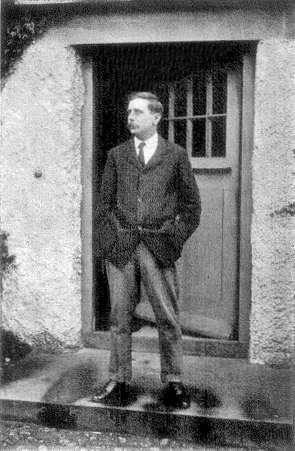
HG Wells at Sandgate, and soon with you again 

          The news came at a reading-aloud of Wells’s short story The Door in the Wall about a man who keeps seeing the same tempting door in the same wall but in  different parts of London.   At the lectern was Robert Lloyd Parry, the actor-producer exponent of one-man


Image result for Robert Lloyd Parry photo
Robert Lloyd Parry: warning of HG Wells tidal wave
photo courtesy Nunkie Productions
re-enactments best-known for his M.R James ghost stories. The night location was a mysterious public house tucked away down an obscure historic alley  in the city of London.

Titles with a head start


THE Sherlock Holmes stories are off to a head start with the reader because of their gripping titles--especially the startlingly descriptive. For instance, The Blue Carbuncle, The Crooked Man, and The Red-Headed League. Even if you don’t finish the story, out of curiosity you’ll definitely start it. I’d be surprised if you didn’t also want to finish it.

Good in part


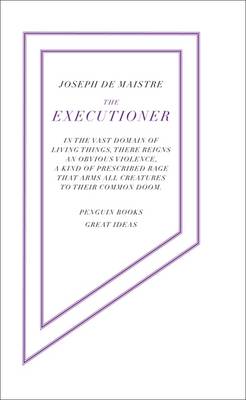
THINKERS have had some great ideas. Penguin have been inspired by the saying cheap is superior (£4-99 at present).  They have taken great ideas and called the series Great Ideas. Retrieved from each thinker’s major works are neatly distilled sections that have made him or her famous or notorious. I’m trying Darwin and Maistre. Both caused a stir in their times. Darwin opens saying that Nature we admire is constantly eating itself to recreate. Maistre, coincidentally, but not till his page 86, points out that every second violence is going on somewhere, and man is the greatest exponent.
     There is more to these two, and other ideas

The Executioner - Penguin Great Ideas (Paperback)
Good to look at, very good to handle. See page 86 for the famous  Maistre passage

 are presented in aesthetically designed small editions, with embossed covers. Their spines (the books’, not the thinkers’) are thin, but skilfully coloured to catch the eye on the shelves.

Cheap is the new superior


WORDSWORTH--the publishers, not the poet-- have raised the status of the cheap edition to superior. No longer can you look down on such a paperback. They even have introductions, the absence of which in a cheap edition used to be a sign of  cost-cutting.
Wordsworth paperbacks appear on  our library shelves in the endearing clear-plastic protective covers, filling gaps that other, older volumes have left by their absence or  banishment to reserve stock.
When I wanted Sherlock Holmes stories, collections now  not always deserving of a place on the shelves, there was a worthy Wordsworth edition of his Adventures and Memoirs,   shining with


Not even his adventures and memoirs, but  here the complete Sherlock Holmes
the admirably gaudy  cover of the great man in red smoking jacket and puffing his pipe. Inside, of course, an introduction and notes. The stories about a man who tries to stay young by foul means not fair, and the original  dog in the night-time, and others,  inhabit the pages.
No price, as a matter of interest, is printed anywhere, but  probably so the seller can charge less, not more, if we’re talking bargain books and not library. In the 1990s, when they started, Wordsworth sold each book for £1.

Diary entry

DIARY  10 March 2016
I heard good things about the 16th century French essayist Montaigne, about his being easy to read and detesting cruelty as if he were in the 21st century. Borrowed his complete Essays, a fat library paperback, but it was overwhelming. Despite my worries about selected works (see this blog), Montaigne’s The Essays: A Selection, edited by M.A. Screech, is better. Less is more.. I have  more strength  to consider his multitudinous views on cats, Roman tyrants and almost everything else. For someone who died more than four centuries ago he is, as the Editor says, ‘utterly readable’.